Politeness in Italian is more than adding per favore. Learn the forms that make a request, interruption or greeting sound natural in context.
What makes a phrase polite in Italian?
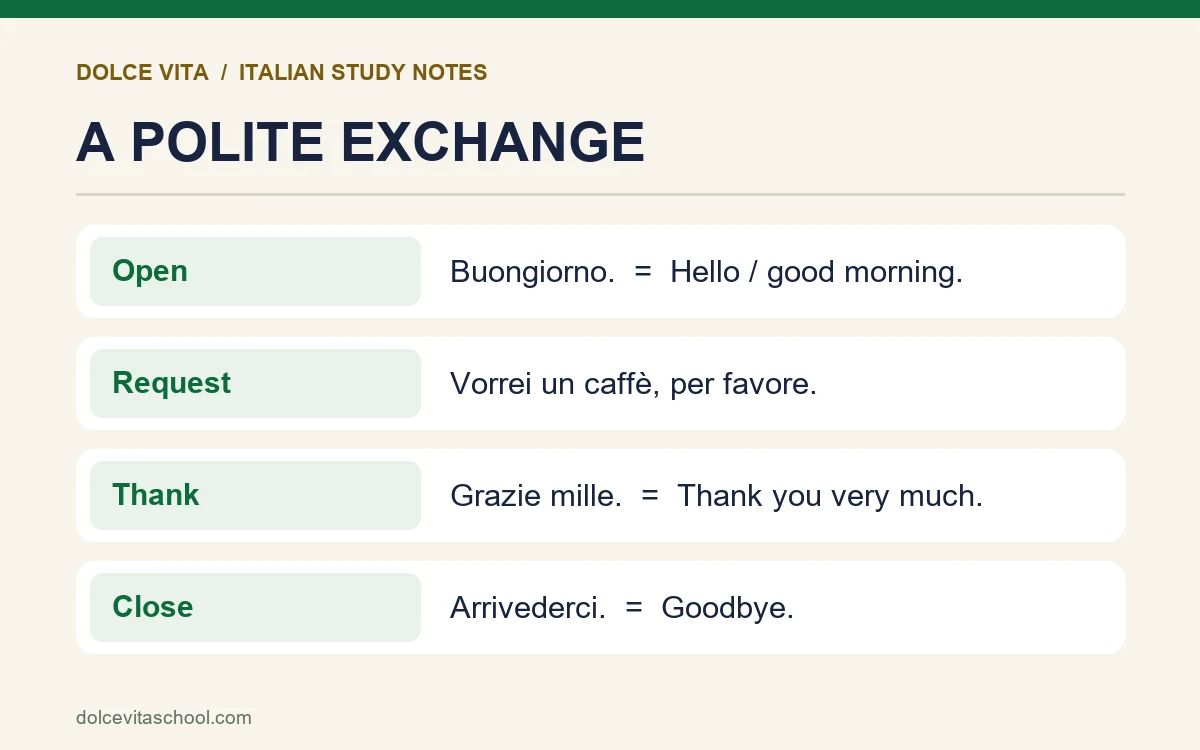
Tone, greeting and verb choice all matter. A short buongiorno before a request and grazie afterward often sound more natural than translating a long English sentence word for word.
- Buongiorno, vorrei un caffè, per favore.
- Grazie. Arrivederci!
How do you say please?
Per favore and per piacere both mean “please.” Add them to a request, but choose a suitable request form too. A direct command plus per favore can still sound abrupt.
- Un tavolo per due, per favore.
- Mi può aiutare, per piacere?
How do you say thank you?
Grazie is the everyday choice; grazie mille or molte grazie add warmth. Reply to thanks with prego, figurati among friends, or di niente in informal contexts.
- Grazie mille! = Thank you very much!
- Prego. = You’re welcome.
When do you use scusi and scusa?
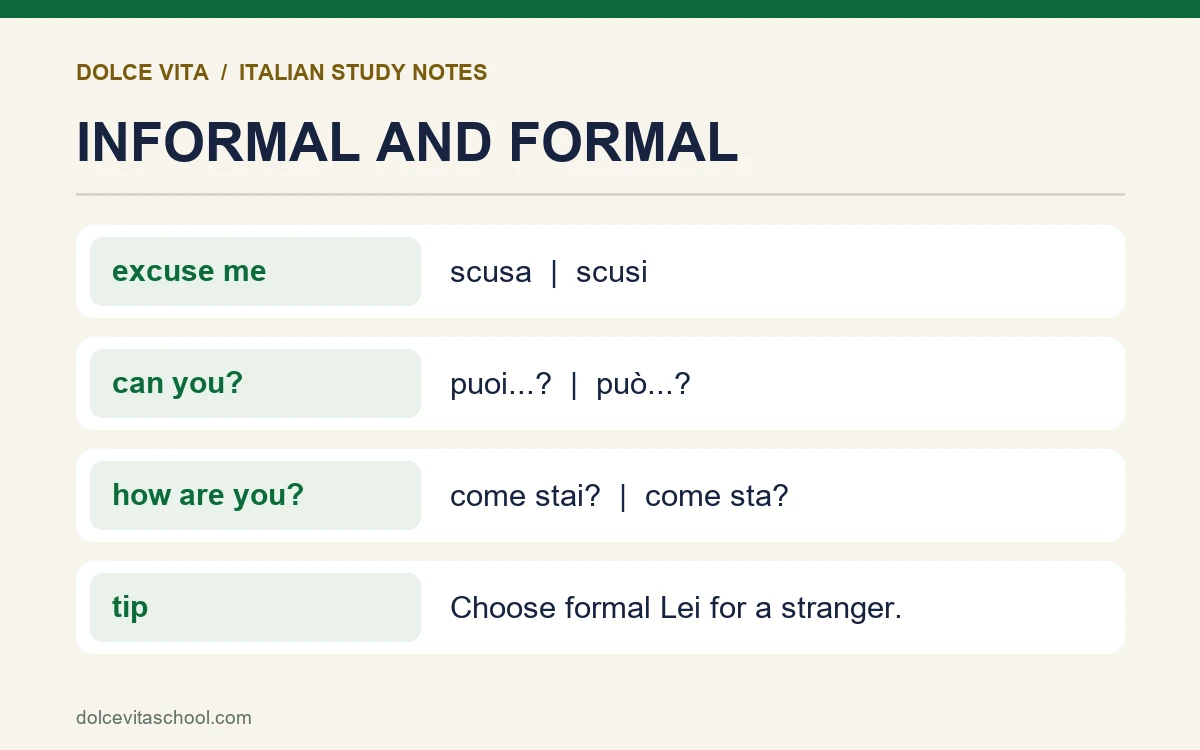
Scusi addresses someone formally or someone you do not know; scusa is informal singular. Use either to attract attention, interrupt or apologise lightly.
- Scusi, dov’è la stazione? = Excuse me, where is the station?
- Scusa, arrivo tardi. = Sorry, I am late.
What does mi dispiace mean?
Mi dispiace expresses regret or sympathy and can function as “I’m sorry.” For a small interruption, scusi may be more natural. Match the phrase to the situation.
- Mi dispiace per il ritardo. = I’m sorry for the delay.
- Mi dispiace molto. = I’m very sorry.
Why is vorrei useful?
Vorrei means “I would like” and softens an order in a café, hotel or shop. Follow it with the item or an infinitive.
- Vorrei un’acqua naturale. = I’d like still water.
- Vorrei prenotare un tavolo. = I’d like to book a table.
How do you ask “could you” politely?
Use può plus an infinitive when addressing a person formally, or puoi with someone informal. A question sounds less forceful than a bare command.
- Può ripetere, per favore? = Could you repeat, please?
- Puoi parlare più piano? = Can you speak more slowly?
When do you use formal Lei?
Formal Lei addresses one person respectfully, often an unfamiliar adult, professional or service worker. It takes third-person singular verbs even when you speak directly to the person.
- Lei ha un momento? = Do you have a moment?
- Come sta? = How are you? (formal)
Which greetings fit the situation?
Buongiorno works through much of the daytime, buonasera later, and arrivederci for parting politely. Ciao is natural with friends but less safe as a first greeting to a stranger.
- Buongiorno, signora. = Good morning / hello, madam.
- Arrivederci e grazie. = Goodbye and thank you.
How do you decline politely?
Say no, grazie for a simple refusal, then add a brief explanation if useful. The phrase does not need to become elaborate to be respectful.
- No, grazie. Sto bene così. = No, thank you. I’m fine as I am.
- Mi dispiace, oggi non posso. = Sorry, I can’t today.
What should you avoid translating literally?
English “please” is not a magic repair for every imperative. In Italian, the conditional vorrei and questions with può often carry the politeness that English puts into a longer formula.
- Prefer Vorrei il conto, per favore to Dammi il conto, per favore.
- Prefer Mi può dire…? when addressing a stranger.
How can you practise these phrases?
Rehearse three short exchanges: ordering, asking directions and correcting a misunderstanding. Keep the greeting, request and thanks together so the whole interaction feels natural.
- Buongiorno. Scusi, dov’è il museo? Grazie!
- Buonasera. Vorrei prenotare per due, per favore.
Use these requests alongside practical Italian restaurant phrases.
Compare polite requests with the Italian imperative so you can hear the difference in tone.
Frequently asked questions
Quick answers to common questions about learning Italian online.
This guide is published by Dolce Vita Italian School, an online Italian school for English speakers. Learn more about the school and its founder, Denise Di Luzio.
Have a question about an example? Contact the school. For guided practice, explore live Italian courses.