
A few question words unlock real conversation: who, what, where, when, why and how. Learn where to place them and how to answer naturally.
How do Italian questions work?
Italian usually keeps statement word order and turns the sentence into a question through intonation. A question word commonly comes first when you ask for specific information.
- Parli italiano? = Do you speak Italian?
- Dove abiti? = Where do you live?
When do you use chi?
Chi means “who” or “whom.” It can identify the person doing an action or the person affected by it. The verb and surrounding words clarify the role.
- Chi arriva? = Who is arriving?
- Chi aspetti? = Whom are you waiting for?
How do you ask “what” in Italian?
Che cosa, cosa and che can all introduce many everyday “what” questions. Che cosa is clear for beginners; cosa is common in conversation. Che also stands before a noun as “which/what.”
- Che cosa fai? / Cosa fai? = What are you doing?
- Che libro leggi? = What book are you reading?
When do you use quale?
Quale means “which” when you are choosing or identifying one option. It changes to quali in the plural. Before a form of essere, qual is written without an apostrophe.
- Quale corso preferisci? = Which course do you prefer?
- Qual è il tuo nome? = What is your name?
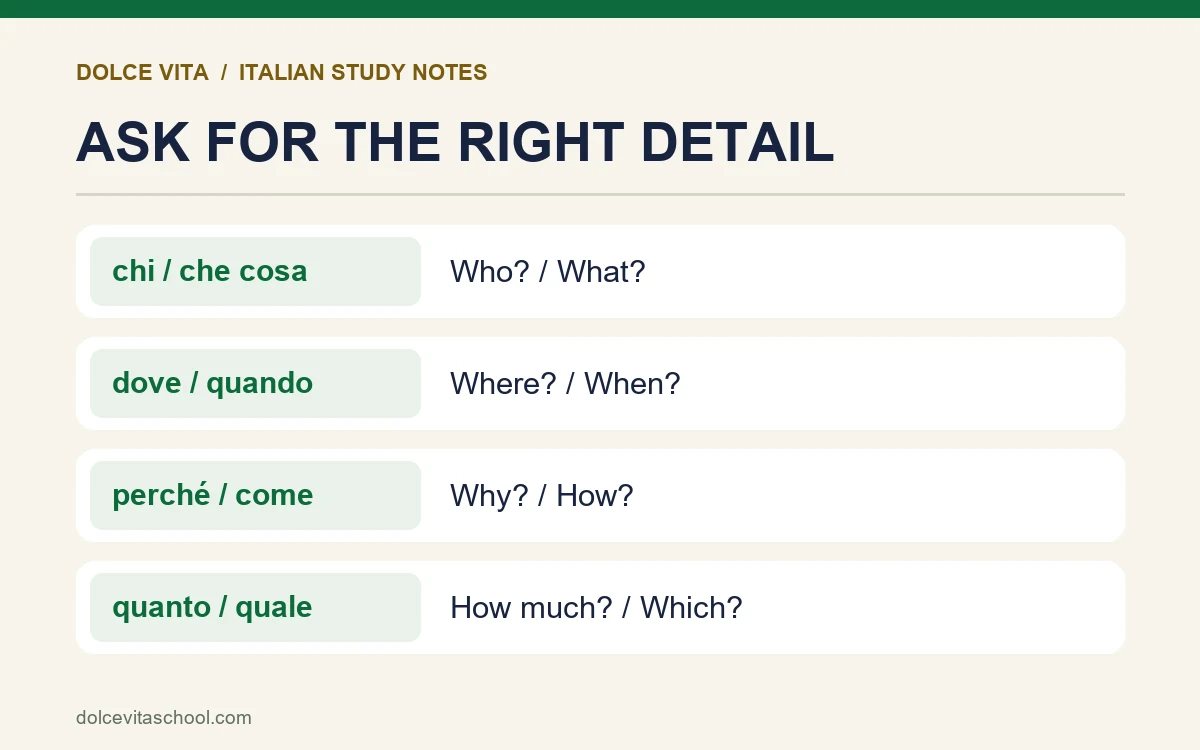
How do you ask where with dove?
Dove asks about a place or direction. Combine it with a verb that fits the meaning; Italian often uses a or in to mark the destination separately.
- Dove sei? = Where are you?
- Dove vai? Vado a Firenze. = Where are you going? I am going to Florence.
How do you ask when with quando?
Quando asks for a time, day or occasion. An answer can be a clock time, a date or a phrase such as domani or dopo pranzo.
- Quando partite? = When are you leaving?
- Partiamo domani mattina. = We leave tomorrow morning.
What does perché mean in a question?
Perché asks “why.” The same word can mean “because” in an answer. The accent is part of its spelling and distinguishes the stressed ending.
- Perché studi italiano? = Why do you study Italian?
- Perché mi piace. = Because I like it.
How do you use come?
Come asks “how” and appears in common expressions about names, wellbeing and methods. Do not translate English “how” word by word when Italian has a set phrase.
- Come stai? = How are you?
- Come ti chiami? = What is your name?
How do you ask how much or how many?
Quanto changes form to agree with the noun it describes: quanto, quanta, quanti or quante. Alone, it can ask for an amount, a price or a quantity.
- Quanto costa? = How much does it cost?
- Quanti studenti ci sono? = How many students are there?
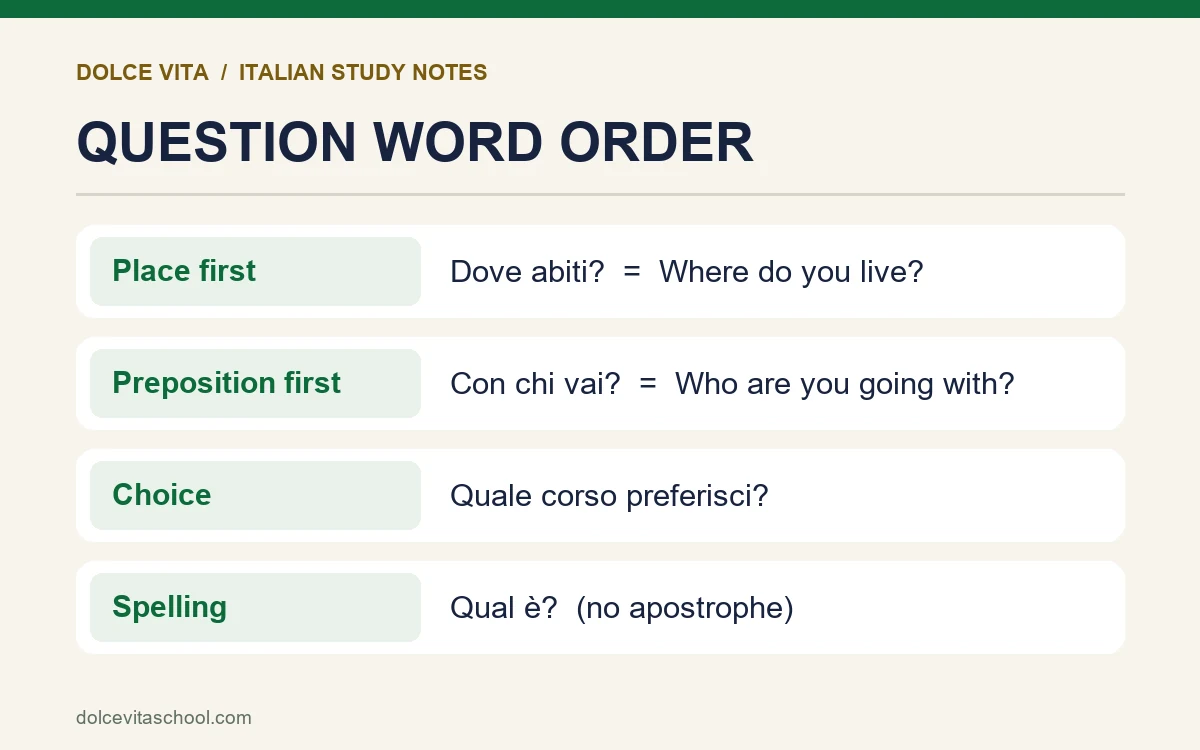
What happens with prepositions?
A question word may follow a preposition. The preposition expresses “from,” “with,” “for” or another relation; do not leave it at the end as English often does.
- Con chi vai? = Who are you going with?
- Da dove vieni? = Where are you from?
Which question mistakes should you avoid?
Do not add English do/does, invert a verb mechanically or omit the accent from perché. For choice questions, check whether you need quale rather than dove or che cosa.
- Dove lavori?, not Do lavori dove?
- Qual è, not qual’è
How can you practise asking questions?
Turn one sentence into five questions, each changing the information requested. Then answer aloud in a full sentence; this builds both question formation and listening readiness.
- Marco parte domani per Roma. → Chi parte? Quando parte?
- Dove va Marco? Perché va a Roma?
Use the Italian present tense to build your first complete questions.
Put these question words to work with practical Italian travel phrases.
Frequently asked questions
Quick answers to common questions about learning Italian online.
This guide is published by Dolce Vita Italian School, an online Italian school for English speakers. Learn more about the school and its founder, Denise Di Luzio.
Have a question about an example? Contact the school. For guided practice, explore live Italian courses.